Community Food Connections in Review
For more than two decades, one of the core elements in Alchemist Community Development Corporation’s work has been a willingness to experiment with new projects, programs, and approaches in response to opportunities and community need. Community Food Connections was one such project, bridging gaps in the food system to get groceries to Sacramento City Unified School District families who were most vulnerable to hunger. The project operated from 2020-2026.
At its peak, Community Food Connections served more than 2,800 neighbors across 40 campuses each month! This reprsented 1,649 children and 1,151 care-givers and family members in 647 households who received groceries every 1 or 2 weeks.
How did it work?
Alchemist CDC partnered with local public schools to identify high-need food-insecure families. A local school liaison (such as a school social worker or a member of homeless services staff) identified families in need, conducted a thorough needs assessment, and then connected them to the program. Additional periodic assessments were done with participating families to identify changes in need and effectiveness of the program. Special priority was given to homeless families and other families who have barriers to accessing traditional emergency food distribution sites (e.g., seniors or other health-vulnerable family members in the household, lack of transportation, single caregivers, etc.).
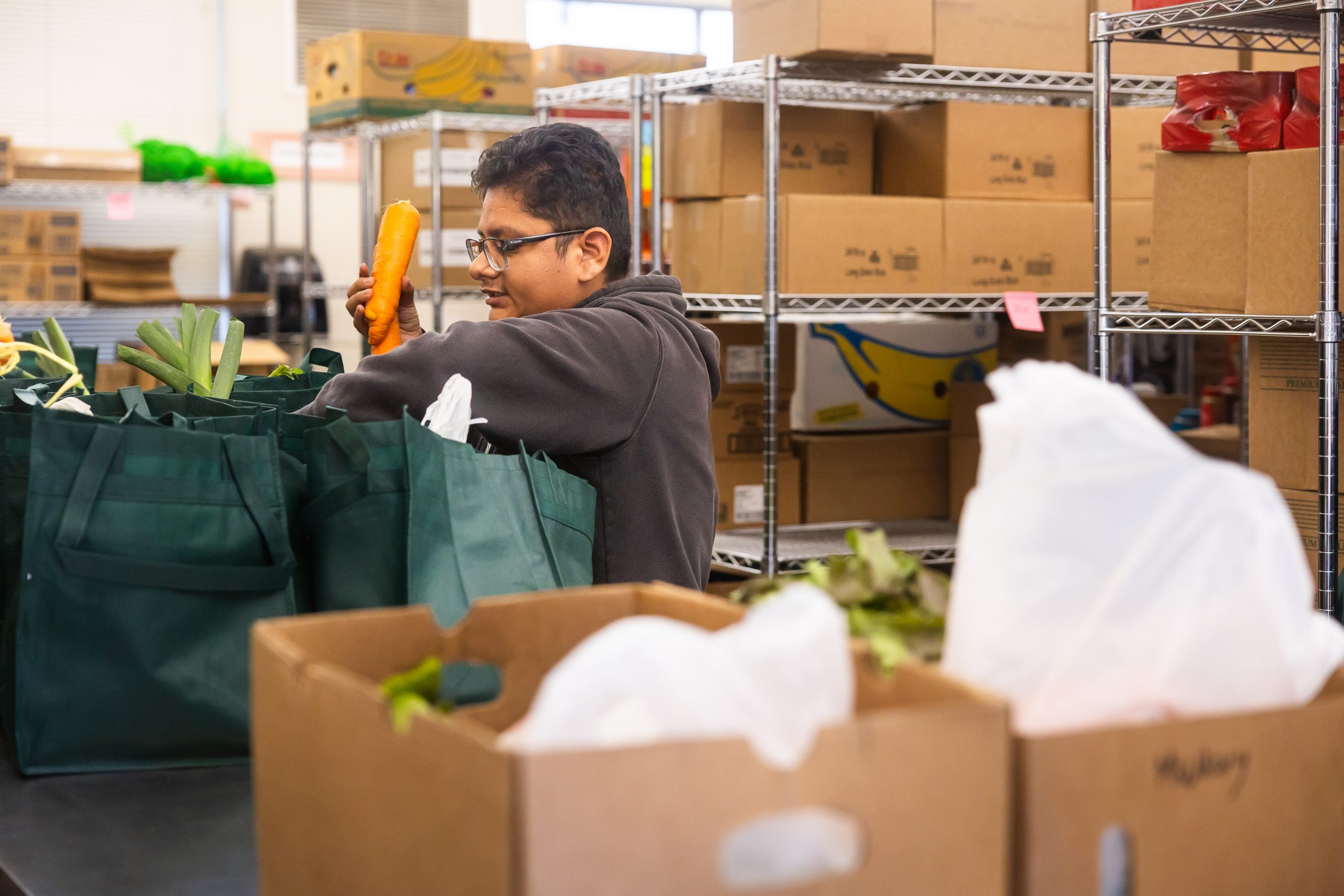
We distributed groceries to families through different methods, specific to their needs. Some families with limited transportation received a delivery of groceries to their door every week. Others picked up their groceries on a regular basis from the social worker at their child’s school. Families who had the ability to prepare meals (such as those who have access to a kitchen) received a combination of shelf-stable grocery staples and local farm-fresh produce. Those families who did not have the means to cook food received “snack bags” filled with foods that could be eaten without any preparation.
Family Resources
- Does your household need assistance? Contact your campus social worker.
- Do you receive CalFresh and want it to go further buying fresh fruits and vegetables? Learn more about CalFresh & Market Match programs that can double your benefits at local farmers’ markets.
- Do you need to find free food? View the Sacramento Food Bank & Family Services’ Food Finder tool.
Where did the food come from?
We prioritized purchasing our produce from small-midsize local growers whenever possible, resulting in additional economic support for our region. For example, the same high-quality produce that the Root 64 urban farm sells to gourmet Sacramento restaurants was delivered to families participating in Community Food Connections from the project’s start. Alchemist CDC has also begun converting individual garden plots at the Oak Park Sol Community Garden into community plots in order to grow fresh produce for CFC households. We are also working to pilot a project with farmers at our certified farmers’ markets to redirect produce left over at the end of a market day to feed these families rather than compost piles.
Other grocery staples are provided by Sacramento Food Bank and Family Services. These are delivered to our Community Food Connections headquarters at the SCUSD Enrollment Center, where they are stored until they are packed for distribution.
How did Community Food Connections start?
In the earliest days of the COVID-19 pandemic, vulnerable families in Sacramento faced new challenges in accessing food as school campuses moved to virtual learning and some neighborhood food pantry sites closed. At the same time, small local farms who depended on restaurants as customers suddenly lost much of their business. In response, multiple organizations joined together in a partnership called “Community Connections 95820” to purchase fresh produce from local farms to distribute to the most vulnerable school district families in the 95820 ZIP code. An early account of this history can be found at Comstock’s Magazine.
In late 2023, Alchemist CDC’s role changed from serving as the fiscal sponsor to operating the project. Around this time, Sacramento City Unified School District set aside a room at the Serna Center administrative campus to function as a Food Access Center and No Kid Hungry committed funding to support the project throughout 2024. With increased resources, the project was able to support many more families at dozens of campuses. Produce from local farms was combined with grocery staples provided by Sacramento Food Bank & Family Services.